October 13, 2026
The Universe Just Smiled at Us
NASA/ESA/STScI (Hubble Space Telescope)
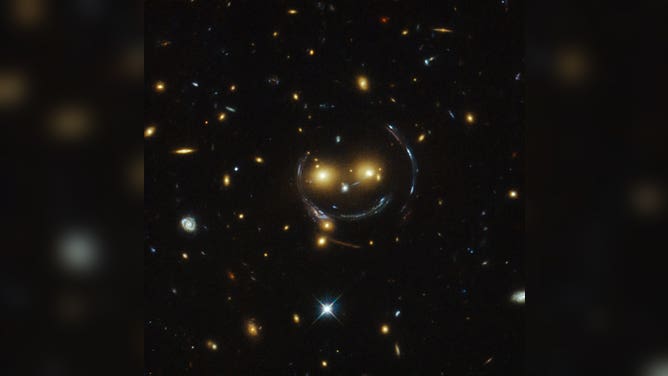
A galaxy cluster, winking at the camera
NASA's Hubble Space Telescope caught a galaxy cluster arranged like a smiley face — and shared it this weekend. The two bright "eyes" are genuinely orange galaxies. The small "nose" is a white galaxy. And the smile itself is the best part: arcs of light from an even more distant galaxy, stretched and bent around the cluster by its gravity.
The image was originally captured back in 2015, in a patch of sky cataloged as SDSS J1038+4849. It's not a new observation — it's a new favorite.
The smile lines are gravitational lensing
What you're looking at is gravitational lensing, one of the most beautiful predictions of Einstein's general relativity: massive structures warp spacetime itself, and light traveling past them bends, distorts, and magnifies — the cluster acts as a cosmic lens.
The "smile" arcs are the smeared, magnified image of a background galaxy sitting far behind the cluster. The cluster's enormous mass bends that galaxy's light around itself like a lens.
Why astronomers love these natural telescopes
Lensing isn't just photogenic — it's one of astronomy's most useful tools:
- A natural magnifying glass: lensing amplifies galaxies that would otherwise be too faint or distant to detect at all, letting Hubble study the far universe through the cluster's gravity.
- A dark-matter map: by measuring exactly how background light bends, astronomers can map the distribution of dark matter inside the cluster — matter that emits no light but betrays itself through its gravity.
Look closely and the frame is full of bonus detail: orange and white galaxies sprinkled across the background, and one bright star with diffraction spikes sitting at the bottom of the image.
Our take
We spend most of our time reading instrument data — counts, magnitudes, redshifts. Then the universe arranges a galaxy cluster into a smiley face and reminds us that wonder is also a data point. The physics behind it — warped spacetime, invisible matter mapped by bent light — is the real punchline, and it's all verified science.
No hype here. Just a cosmic lens, doing its thing, looking cheerful about it.
Facts verified against Fox Weather and the New York Post, both reporting Oct 12, 2026, on NASA's release. Image: NASA/ESA/STScI via the Hubble Space Telescope.
Source: Fox Weather — read the original report
← Back to latest stories