October 18, 2026
The 6.9 That Made Headlines — and the M9.9 That Never Happened
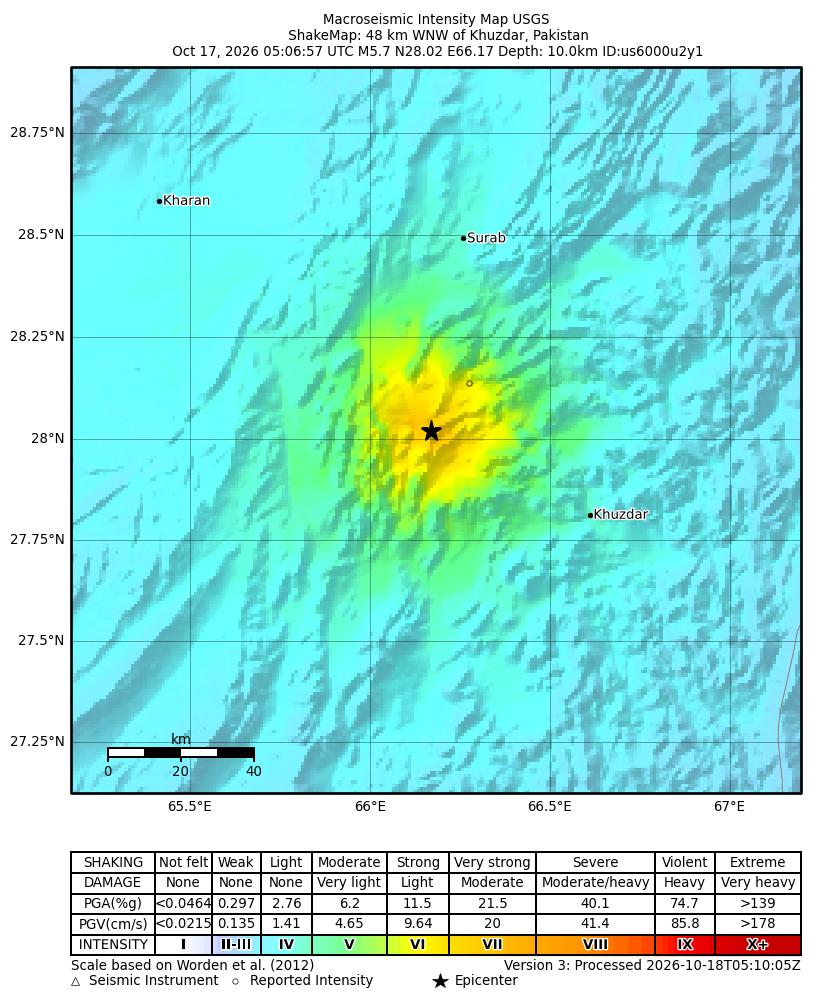
USGS ShakeMap for the Oct 17 M5.7 Khuzdar, Pakistan earthquake
The biggest earthquake of the week didn't make headlines. A headline about the week's biggest earthquake did.
A real 6.9 — and a phantom 9.9
Late Thursday night, a magnitude 6.9 struck off the Kamchatka Peninsula in Russia — 76 kilometers northeast of Ozernovskiy, and deep: 135 kilometers down. The USGS issued a green alert (low likelihood of damage or casualties), and the whole thing drew just two "Did You Feel It?" reports. No damage. No tsunami.
But across the sea in Japan, the automated earthquake early-warning system took that real quake and misread it spectacularly. The Japan Meteorological Agency's system mislocated the epicenter to the Kuril Islands and estimated a magnitude of 9.9.
A 9.9 would have been the largest earthquake ever recorded — bigger than the magnitude 9.5 Valdivia earthquake of 1960, the most powerful quake modern instruments have ever measured. Emergency alarms sounded across a huge swath of Japan, from Hokkaido down through central Honshu. Tokaido Shinkansen bullet trains were automatically halted.
Then, about eight minutes later, the warning was withdrawn.
At a briefing the next afternoon, JMA officials apologized and said the cause is under investigation — the problem appears to be in information processing, not hardware, and there's no indication of a cyberattack. The system had detected the seismic waves and marched through normal early estimates (6.2 to 7.6) before the 9.9 appeared in one update and never left. According to Japanese reporting, it was the first time the agency has ever cancelled an early warning issued at its highest alert level.
It's a reminder of the brutal tradeoff inside early-warning systems: every extra second of data buys accuracy but costs warning time. JMA chose speed. For eight minutes, much of Japan braced for an earthquake that never existed.
The quake that did real damage was much smaller
Early Saturday morning, a shallow magnitude 5.7 struck near Khuzdar in Pakistan's Balochistan province — just 10 kilometers deep. Shallow is what turns a moderate number into a serious one: the USGS ShakeMap shows shaking up to intensity VII near the epicenter, and the PAGER alert level came out yellow, meaning some casualties or damage were possible.
They were. Pakistan's Dawn newspaper reported one death — a resident of Wadh killed by a falling rock in the Naal area — and damage to several mud houses. Quakewire's report notes the figures have been revised multiple times since the first bulletin, which is normal for the first day after an event. If the casualty picture changes, we'll update this.
The most-felt: Alaska, 4.5 km deep
The earthquake the most people reported feeling wasn't close to the week's biggest: a magnitude 5.6 near Lake Minchumina in interior Alaska on Thursday morning. One hundred and six "Did You Feel It?" reports, shaking estimated up to intensity VII — and a depth of just 4.5 kilometers. Depth is everything: energy released that close to the surface doesn't have far to travel before it rattles a house.
No injuries were reported.
The rest of the log
- M6.0, 126 km south of Kokopo, Papua New Guinea (Tuesday) — green alert, one felt report.
- M5.9, Fiji region (Wednesday) — 585 kilometers deep, which is about as deep as earthquakes get, and felt by no one.
- M5.4, off the coast of Ecuador (Thursday) — unfelt.
Since our last watch on Tuesday: 218 earthquakes of magnitude 2.5 or greater, 61 of them 4.5 or stronger. Two reached magnitude 6.
Read the instruments, not the tea leaves
We don't forecast here — nobody can. A 6.9 deep under Kamchatka, a shallow 5.7 in Balochistan, a false 9.9 in Japan: the ground does what it does, the instruments report it, and the best any of us can do is pay attention without panicking.
Sources: USGS-tracked public earthquake feeds (event pages us6000u2mq, us6000u2y1, aka2026ukynnb, us6000u24c, us6000u28y); JMA false-warning details via watchers.news (Oct 16, 2026) and The Orbit Post / Dawn (Khuzdar casualties, Oct 18, 2026).
Source: USGS — read the original report
← Back to latest stories