October 10, 2026
A flash of radio waves just crossed 10 billion years of space to reach us
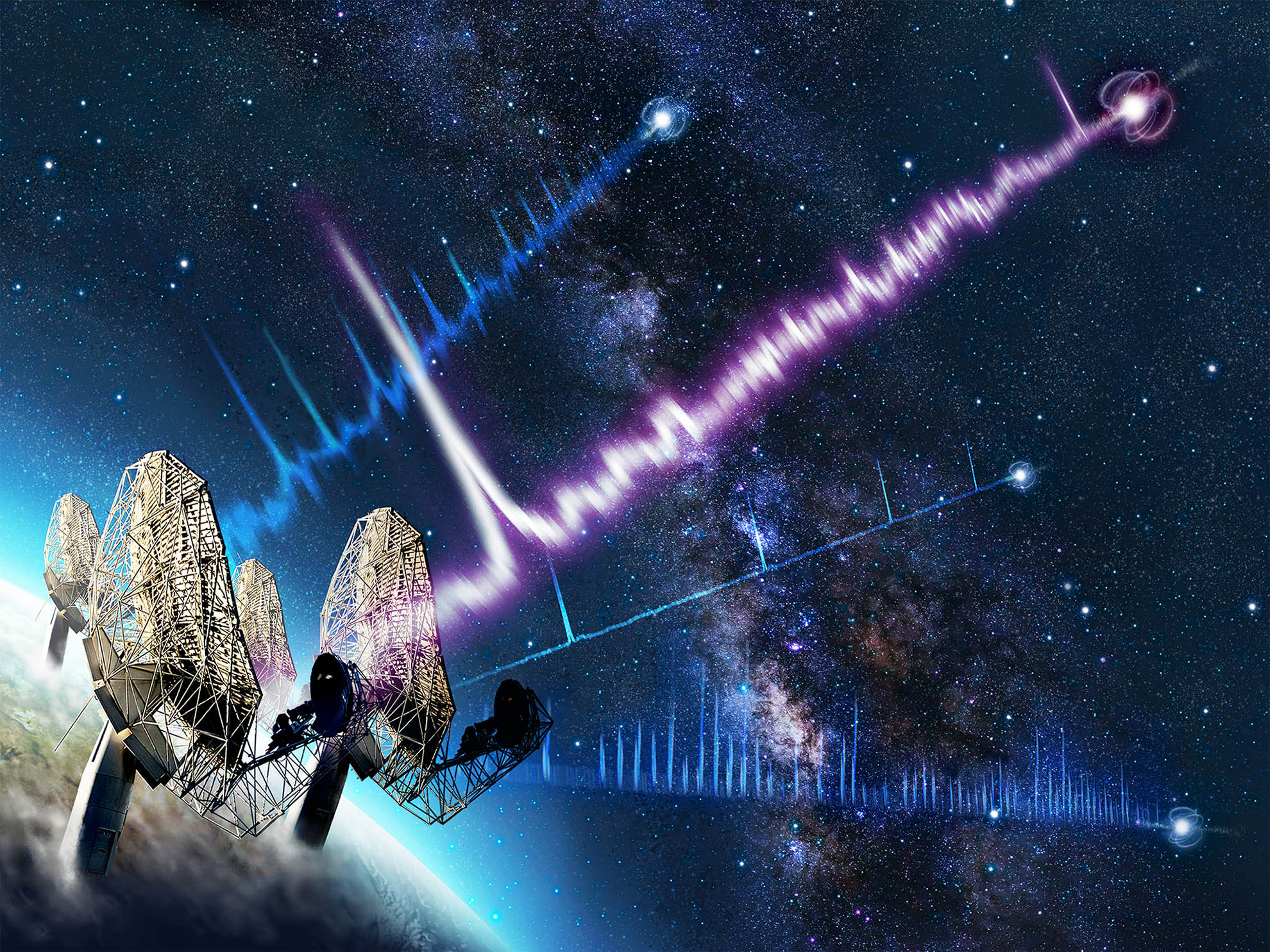
SARAO (South African Radio Astronomy Observatory)
Something screamed in radio for a few milliseconds — and its echo just reached us from 10 billion years ago.
Astronomers have detected and pinpointed the most distant fast radio burst ever recorded: FRB 20240304B. Fast radio bursts are among the strangest phenomena in the sky — flashes of radio waves lasting only milliseconds, releasing enormous amounts of energy, from sources we still can't fully explain.
What the team found
The discovery, led by researchers Manisha Caleb and Themiya Nanayakkara at the University of Sydney, was published in the journal Science. South Africa's MeerKAT radio telescope caught the flash through the MeerTRAP project — and then the team did the hard part: finding where it came from. The host galaxy was invisible to the largest ground-based telescopes. It took NASA's James Webb Space Telescope to pinpoint it and measure its distance.
The numbers are the story here. The burst left its home galaxy when the universe was only about 3 billion years old. Its signal traveled across more than 10 billion years of space before reaching Earth — more than doubling the previous distance record.
"An extraordinary glimpse into the distant universe," Caleb said — one brief flash of radio light, used to learn about the matter it traveled through over billions of years.
The clue in the home galaxy
The host galaxy turned out to be an unexpected source: surprisingly small, metal-poor, and undergoing a very active episode of star formation. That's an important clue, because it points toward one leading theory of what makes fast radio bursts — young magnetars, the ultra-magnetized neutron stars born when massive stars explode in supernovas. A young, star-forming galaxy is exactly the kind of place magnetars should be born, and less consistent with alternatives like mergers of ancient neutron stars.
A beacon for the space between galaxies
Beyond the record, the burst acted as a cosmic beacon. As the radio signal traveled across most of cosmic history, it carried information about every wisp of gas and matter it passed through — structures that are otherwise nearly impossible to observe directly. "In principle, sufficiently powerful bursts could be detectable from the very early universe," said co-author Kavya Shaji. The next frontier, in the team's words: pushing this method back toward the first generations of stars.
We're not saying anyone knows what makes these flashes. That's the honest part — the origins of fast radio bursts are still one of astronomy's great open questions. But this one turned a mystery into an instrument: a 10-billion-year probe of everything it passed on the way here.
Listening to the sky yourself
No backyard radio kit will catch a fast radio burst — they're far too faint for anything but giant observatories. But the radio sky is busy with things amateurs can hear: weather satellites, the International Space Station, aircraft signals, and with the right antenna, even the 21-centimeter hydrogen line that radio astronomers use to map the galaxy. The entry point is a software-defined radio (SDR) USB receiver — a small dongle that turns a computer into a radio receiver. Link to the one we checked in the first comment on the Facebook post.
Paper: "A fast radio burst at redshift 2, three billion years after the Big Bang," Science (2026). DOI: 10.1126/science.adz2675.
Source: Phys.org — read the original report
← Back to latest stories