October 24, 2026
The asteroid crime scene is about to get its first inspector
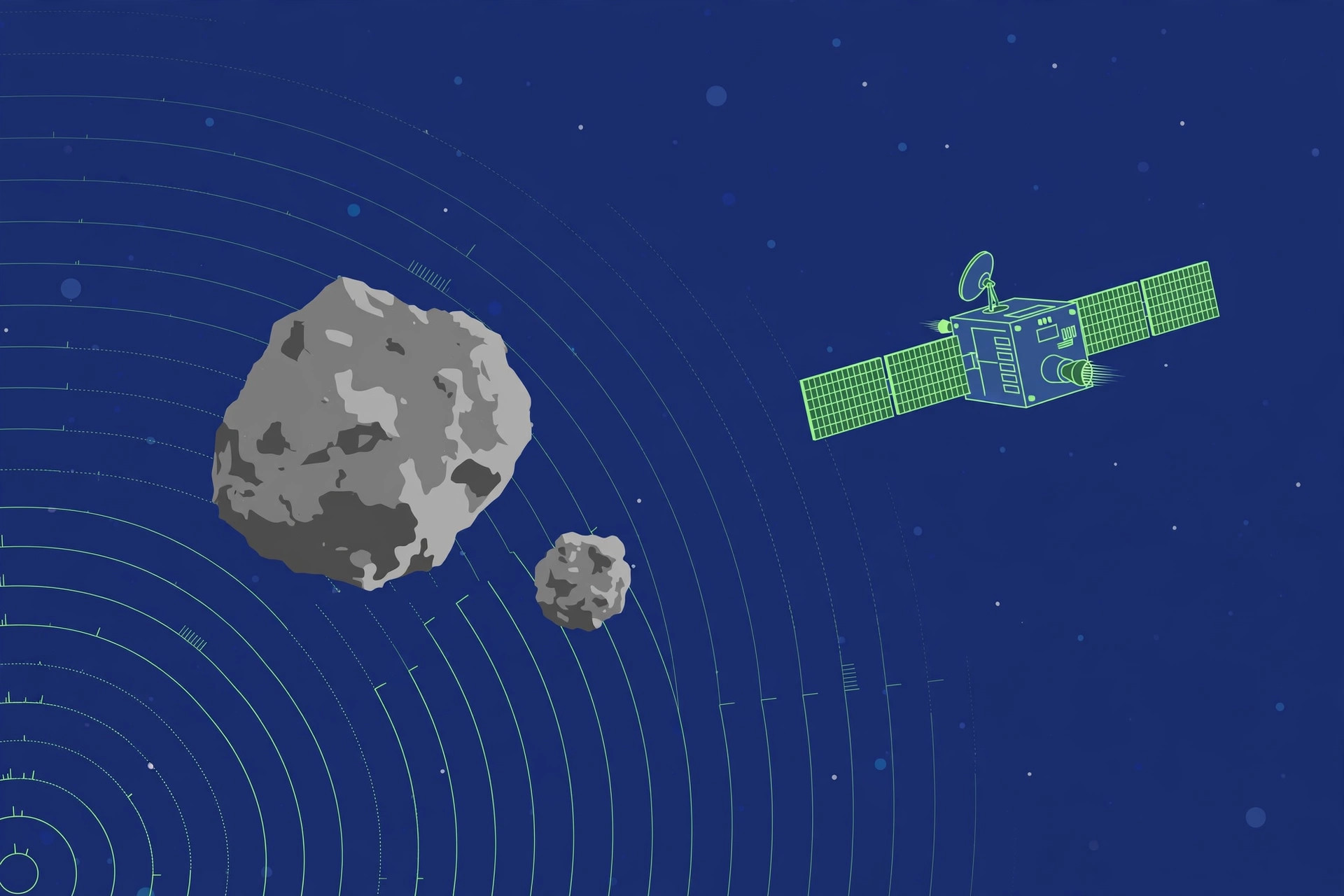
Illustration by The Discovery Wire
The asteroid crime scene is about to get its first inspector
Four years ago, humanity moved an asteroid on purpose for the first time. Now the follow-up inspector is almost at the scene.
In September 2022, NASA's DART spacecraft slammed into Dimorphos — a moonlet about 150 metres across, orbiting the larger asteroid Didymos — and measurably changed its orbit. It was the first real test of whether we could deflect a dangerous asteroid by hitting it. The impact worked. But the details — how much the little moon deformed, how much mass it lost, what the crater actually looks like — have stayed out of reach ever since.
That is what ESA's Hera mission is for. Launched on 7 October 2024, Hera has spent two years cruising to the Didymos system, including a Mars gravity flyby in spring 2025. On 15 October 2026 it fired its thrusters for 93 minutes in its first big braking burn. On 22 October it braked a second time, 2,300 kilometres from the asteroids, shedding another 70 metres per second of relative velocity.
Arrival is set for 4 November 2026. There is no orbit to simply fall into — Didymos's gravity is roughly 40,000 times weaker than Earth's — so Hera will fly a series of slow arcs past the pair, coming within 20 to 30 kilometres of Dimorphos during its early characterisation phase, which runs to mid-December.
What Hera will actually measure
Hera carries two CubeSats, Juventas and Milani, due to be released in January. Juventas will attempt the first radar sounding of an asteroid's interior and eventually try to set down on Dimorphos itself. Milani will map surface composition. The mothership will weigh Dimorphos directly, image the DART impact site, and pin down the asteroid's mass — the missing number that limits how precisely scientists can calculate how efficient the DART deflection really was.
That matters beyond this one rock. A kinetic impactor is only useful if engineers can size a deflection mission against a real threat with confidence instead of educated guessing. DART proved the idea; Hera is supposed to produce the calibrated physics.
The honest unknowns
Hera will not answer everything. Computer models suggest Dimorphos may be a loosely bound pile of debris rather than a solid body — meaning the impact may have deformed the whole moon, not just dug a crater. Whether that is true is exactly what the close-up observations are meant to test. And while this particular asteroid is no threat to Earth, the method only works for threats found years or decades in advance — which is why the survey telescopes that find asteroids matter as much as any interceptor.
The first pictures from the arrival phase are expected around late November. We will be watching.
Sources: ESA Hera mission updates; EarthSky; Wikipedia's Hera mission timeline (citing ESA releases). This is a roundup of a public, third-party mission — no unpublished findings, no predictions.
Source: ESA / EarthSky — read the original report
← Back to latest stories