October 06, 2026
The Milky Way's First Microblazar — a Black Hole Pointing at Earth
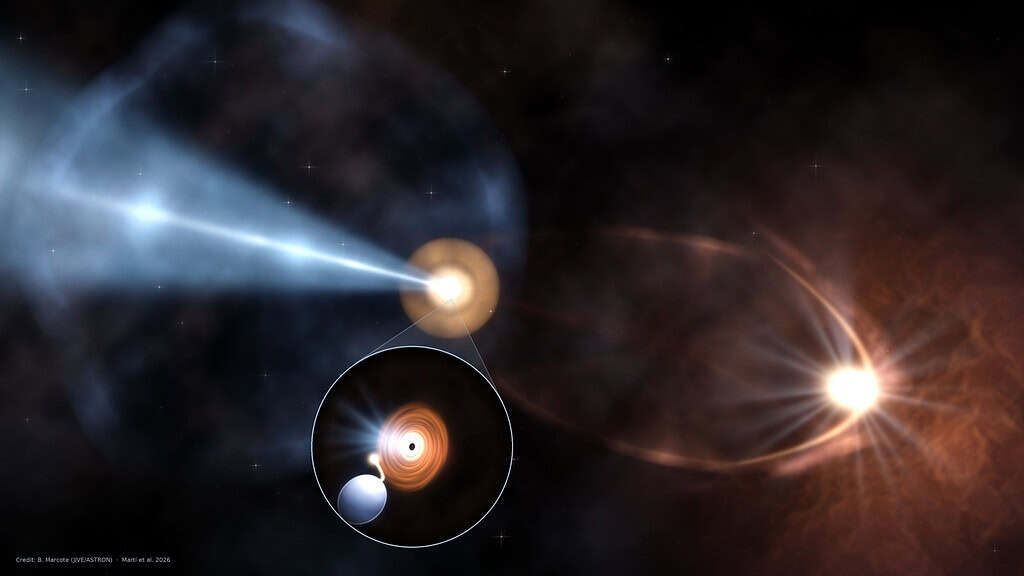
Artist's impression by B. Marcote / JIVE–ASTRON
The Milky Way's First Microblazar — a Black Hole Pointing at Earth
For more than 30 years, astronomers have been hunting a particular kind of black hole — one that theory said should exist in our galaxy, but that no one had ever found. It was hiding in plain sight the whole time.
The object is IRAS 18293−0941, and an international team has now identified it as the Milky Way's first confirmed microblazar: a miniature version of the blazars that rank among the brightest, most violent objects in the universe. The new research, published in Astronomy & Astrophysics, may also explain where some of the galaxy's most energetic particles come from.
A familiar monster, scaled down
Blazars are active galactic nuclei powered by supermassive black holes — millions to billions of times the Sun's mass — firing jets of near-light-speed plasma. When one of those jets happens to point at Earth, relativistic beaming makes the object appear extraordinarily bright.
IRAS 18293−0941 works on the same principle, only its engine is a black hole of roughly ten solar masses stealing material from a massive companion star. The two orbit each other every 11.38 days. Matter spirals into a hot accretion disk, and magnetic fields launch twin jets in opposite directions — one aimed almost directly at Earth from about 12,000 light-years away, the other shooting off in the opposite direction.
There's no danger: 12,000 light-years is an immense buffer. But being pointed at us is what makes the system so useful. "What takes days or weeks to change in a microblazar would take thousands of years in a supermassive blazar," says astrophysicist Pedro Luque-Escamilla of the University of Jaén in Spain. "It's a perfect scale model where we can watch a 'cosmic movie' in fast-forward."
Found in a 1983 catalog
The object was first detected in 1983 by the Infrared Astronomical Satellite, but thick interstellar dust obscured it in visible light, and it sat in a catalog largely forgotten. The team — led by Josep Martí of the University of Jaén, with researchers from ASTRON, JIVE, and the University of Amsterdam — cross-referenced the old catalog with modern radio data and found the telltale signature: a small, very bright emission extending from only one side. That's the "fingerprint of blazars," Martí says.
The clincher came from the European VLBI Network, whose continent-spanning radio telescopes produced razor-sharp images, and ESA's Gaia spacecraft. The jet's position matched the star's position exactly — ruling out a background galaxy. "This was the moment the result became solid," says Benito Marcote of JIVE.
The jet pointed the other way
The real prize may be the jet we can't see. Using South Africa's MeerKAT radio telescope, the team found that the far jet has carved an enormous bubble — roughly 100 light-years long — through the surrounding gas. At the bubble's far end, the jet slams into a dense molecular cloud, heating dust and gas into a bright, energetic region.
And that region sits near a known patch of ultra-high-energy particles — cosmic rays carrying roughly 100 times the energy the Large Hadron Collider can produce. Where those particles come from has been a longstanding mystery. The team's argument: the jet-cloud collision is a natural particle accelerator, and this hotspot is where the acceleration happens.
"A one-sided radio jet on its own could always be from a distant galaxy that happens to lie in the same direction of the star we were studying." — Benito Marcote, JIVE
Because IRAS 18293−0941 is inside our own galaxy, astronomers get a front-row seat: the black hole launching the jet, the 100-light-year bubble it carved, and the collision site where particles gain energy — all in one system. The team is already gathering follow-up observations of the suspected hotspot.
The honest verdict: a predicted class of object, finally found, hiding in a 43-year-old catalog — and possibly the answer to one of the Milky Way's oldest particle mysteries. Not aliens. Just physics, at a scale we can finally watch in real time.
Source: Science News, October 5, 2026; Martí et al. (2026), "A Galactic microblazar as a potential accelerator of ultra-high-energy particles," Astronomy & Astrophysics.
Source: Science News — read the original report
← Back to latest stories