October 13, 2026
A Piece of the Moon, Sitting in Madagascar
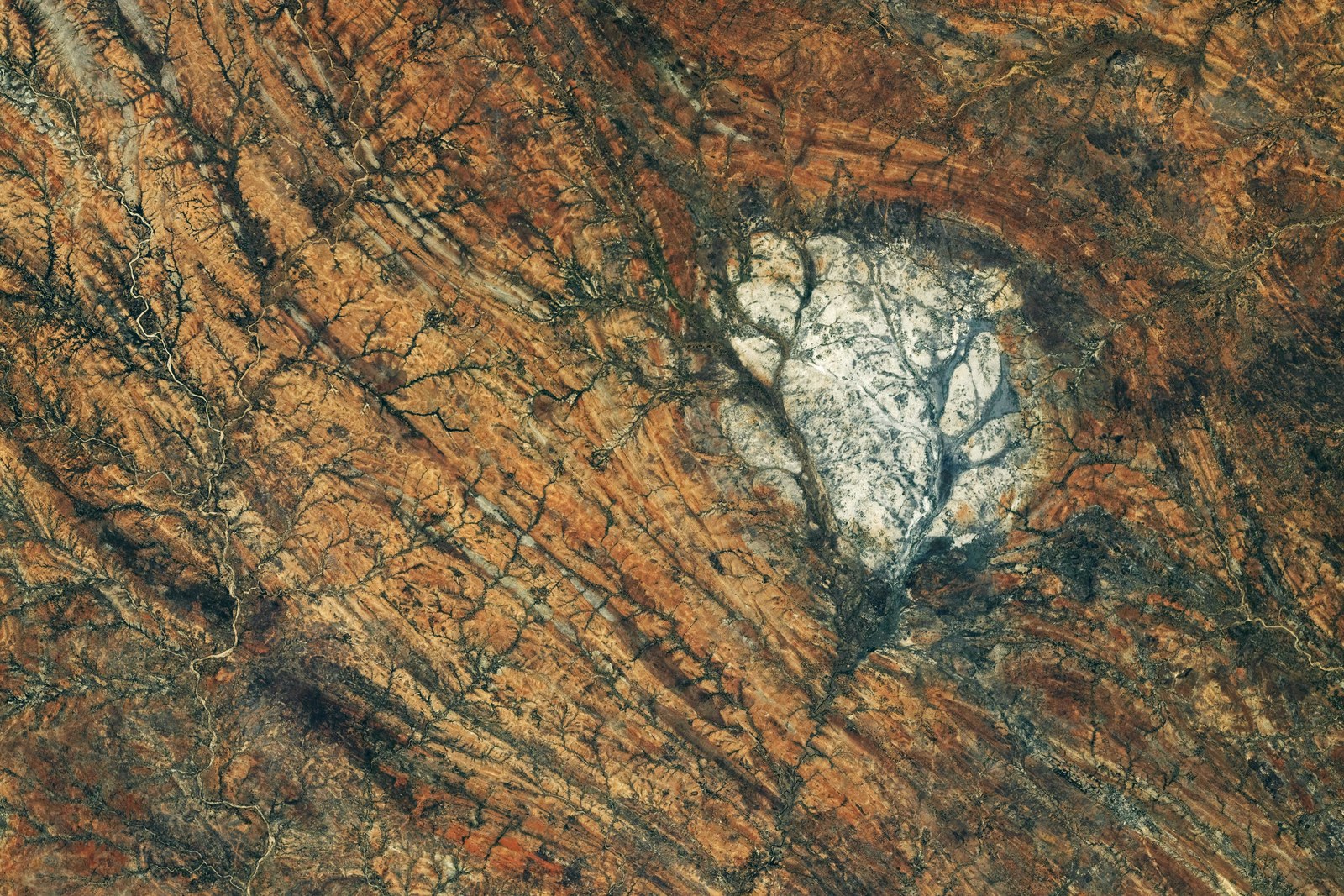
Astronaut photograph ISS075-E-85249, ISS Crew Earth Observations Facility, NASA Johnson Space Center
A Piece of the Moon, Sitting in Madagascar
From 400 kilometers up, most of southern Madagascar looks like rust: orange rock running in long north–south stripes, dry riverbeds branching across it like cracks in old paint. Then, in the middle of all that orange, there is a pale blot — roughly round, nearly white, and seemingly dropped in from another world.
It isn't from another world, exactly. But close: the blot is made of the same rock that forms the Moon's bright highlands.
The Saririaky massif
The formation is the Saririaky anorthosite massif, a body of rock covering about 100 square kilometers (40 square miles) of southern Madagascar. An astronaut aboard the International Space Station photographed it on August 28, 2026, with a Nikon Z9 and a 400-millimeter lens; NASA's Earth Observatory published it as Image of the Day on October 5, 2026.
Anorthosite is an intrusive igneous rock — magma that cooled slowly beneath the surface, growing large mineral crystals. On Earth it's relatively uncommon. On the Moon, it's everywhere: the light-colored, highly reflective lunar highlands you can see with the unaided eye are largely anorthosite, crystallized from the Moon's magma ocean more than 4 billion years ago.
Scientists think Saririaky formed in the late Precambrian, at least 600 million years ago.
Stretched by a supercontinent's birth
The pale round mass held its shape, but the rocks around it didn't. Saririaky sits inside a ductile shear zone — rock buried deep enough and heated enough to bend and smear instead of snapping — which is why the surrounding terrain stretched into those long north–south stripes.
Geologists think that deformation happened when the landmasses that are now Africa, India, Madagascar, Australia, and Antarctica collided to assemble the supercontinent Gondwana. Some researchers have posited that a second anorthosite massif about 60 kilometers to the north was once connected to Saririaky, pulled apart in the collision like taffy — a large-scale boudinage structure.
Why it matters
Lunar anorthosites are more than 4 billion years old, and the Apollo samples are limited — so planetary scientists study terrestrial analogs. Anorthosite also crops up in eastern Canada, Scandinavia, and southern India; the anorthosites of Montana's Beartooth Mountains are thought to match the lunar composition particularly well. Every one of these Earth-bound patches is a window into the Moon's earliest crust.
Sources: NASA Earth Observatory, Oct 5, 2026
Source: NASA Earth Observatory — read the original report
← Back to latest stories