October 13, 2026
Perseverance just set the all-time record for driving on another world
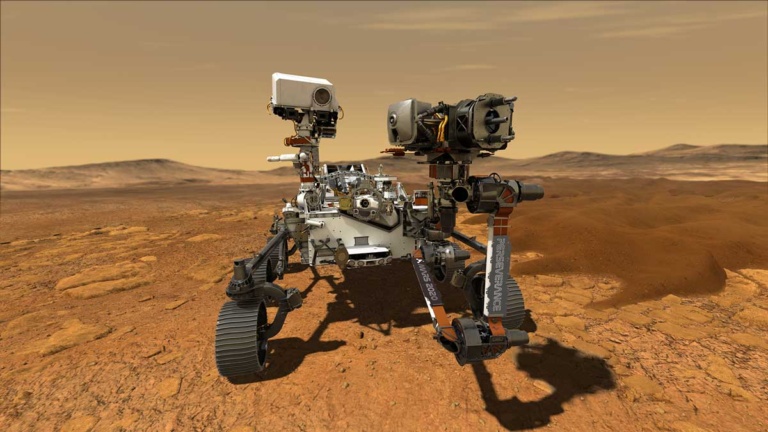
NASA/JPL-Caltech (artist's concept)
A car on Mars just became the farthest-traveled vehicle in the history of other worlds.
NASA's Perseverance rover has now driven 28.1 miles (45.2 km) across Mars — more than any vehicle has ever driven on any surface beyond Earth, the space agency said Tuesday. The previous record belonged to the Opportunity rover, which covered 28.06 miles on Mars between 2004 and 2018. Both have now outdriven every lunar rover as well.
The record fell 5-1/2 years into a mission built around one question: whether conditions on Mars ever supported microbial life.
The robot that drives itself
What makes the mileage remarkable is how it was earned. Perseverance's self-driving system, AutoNav, now handles 90% of its drives with no human intervention. The rover takes stereo images of the terrain ahead, builds a 3D map of the ground, and picks the safest path toward its drive goal — continuously, thanks to a fast co-processor called the Vision Compute Element.
Earlier rovers had to pause and "think" before each drive segment. Perseverance thinks while it rolls.
Where it's headed
The record came during a long trek across Jezero Crater toward an area called Idubi, rolling through terrain nicknamed Lac de Charmes — some of the most ancient ground ever visited anywhere in the solar system. Jezero is an ancient lakebed, and its crater rim may hold hydrothermal areas that once provided warm, watery underground environments where life could have begun.
The rover's original mission called for just 12.4 miles of driving. It has more than doubled that, and NASA has approved an extension to keep exploring the crater rim until around the end of 2028. Project manager Steven Lee of NASA's Jet Propulsion Laboratory says the hardware could keep operating "well into the 2030s."
The real prize
The driving is the journey, not the destination. Last year, Perseverance made what Lee calls its biggest achievement: a potential biosignature — a possible sign of ancient microbial life — in reddish rock believed to be 3.2 to 3.8 billion years old, in what was once a river channel feeding Jezero's lake.
The mileage is how the rover earns the right to keep looking. And it's not done.
Source: Reuters — read the original report
← Back to latest stories