October 23, 2026
The World's Most Mysterious Manuscript May Have Been Read in the Wrong Order All Along
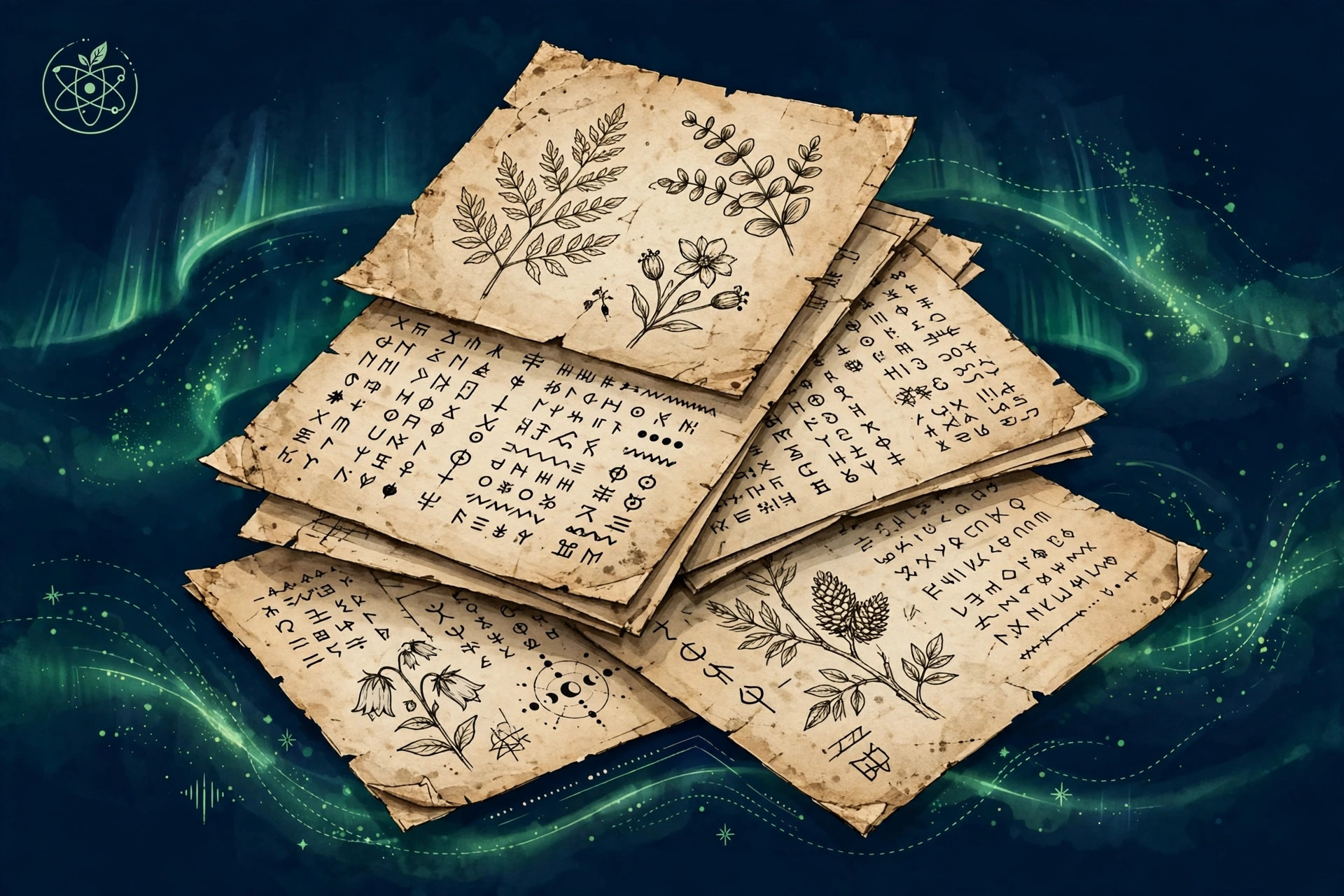
Illustration: The Discovery Wire (generated artwork for this story)
The most studied unread book in the world may simply have been in the wrong order this whole time.
The Voynich Manuscript — 240 pages of vellum, carbon-dated to the early 1400s, filled with fantastical plants, astronomical diagrams, bathing women, and a script no one has ever deciphered — has defeated cryptographers, linguists, and even artificial intelligence for more than a century. Now a study published in the journal Digital Medievalist argues that part of the reason may be embarrassingly simple: the book was misbound, and every researcher has been reading a scrambled text.
Colin Layfield, an information scientist at the University of Malta, and Lisa Fagin Davis, executive director of the Medieval Academy of America, started from a curious observation. Medieval manuscripts are built from quires — booklets of folded pages sewn together — and normally a single scribe writes one quire. But the Voynich manuscript, which Davis has previously shown was written by up to five different scribes, has different scribes alternating within the same quires. In Layfield's words: "Typically a single scribe writes in a quire 'booklet,' but the current binding has different scribes in the same quire, which, to be blunt, is simply not [how it is] done."
There were other anomalies. A large water stain sits in the upper margin of some pages but doesn't line up symmetrically with the pages across from them. And in several places an illustration runs off the edge of a page and reappears not on the facing page but pages later, with unrelated material in between.
To test the idea that the pages are misbound, the researchers applied latent semantic analysis — a technique that compares pieces of text by the words they contain and how those words are used — to blocks of text across pages, leaves, bifolia, and quires, benchmarking the method on known medieval works like the Aberdeen Bestiary. The result: "strong evidence" against the quire structure. Instead, the manuscript was probably designed as a collection of individual bifolia — single sheets folded in half — stacked in sequence, what the authors call singulions. At some point in the mid-to-late 1400s, the stack was nested into quires and bound, scrambling the order.
"Treat them as loose pages stacked together," Layfield told the Guardian, "and all these artistic anomalies suddenly join up."
The finding doesn't deliver a translation — the authors are explicit that the script remains undeciphered. "This means that any research that relies on the current sequence of pages needs to be revisited, since the manuscript is out of order," Davis told Gizmodo. But getting the order right is the prerequisite for everything else: "A book with mixed-up pages makes no sense to anyone," Davis said, "so putting them back in order counts as progress." There is even a precedent for solving scrambled books: Cain's Jawbone, a 1934 murder-mystery puzzle printed with its 100 pages shuffled, has been solved by only four people.
The study also reshapes the story of who made the book. Rather than one mad genius, the five scribes and the singulion structure suggest a communal object — knowledge passed from hand to hand, generation to generation. Davis believes the illustrations point toward women's folk knowledge, possibly about health and reproduction. "I think it's likely we are looking at an object that was made by a community that wanted to pass its knowledge forward," she told the Guardian.
And then there is the irony Davis offered: so few medieval manuscripts survived precisely because loose, unbound pages perish easily. "Whoever misbound this manuscript still did us a huge favor by ensuring its survival," she said. The person who scrambled the world's most mysterious book is also the reason it still exists.
The Voynich Manuscript is housed at Yale University's Beinecke Rare Book and Manuscript Library, where it has been since 1969. It is named for Polish-American bookseller Wilfrid Voynich, who purchased it from a Jesuit college in Italy in 1912.
Source: Smithsonian Magazine — read the original report
← Back to latest stories