October 15, 2026
Webb Just Sniffed Methane on a Visitor From Another Star — A First
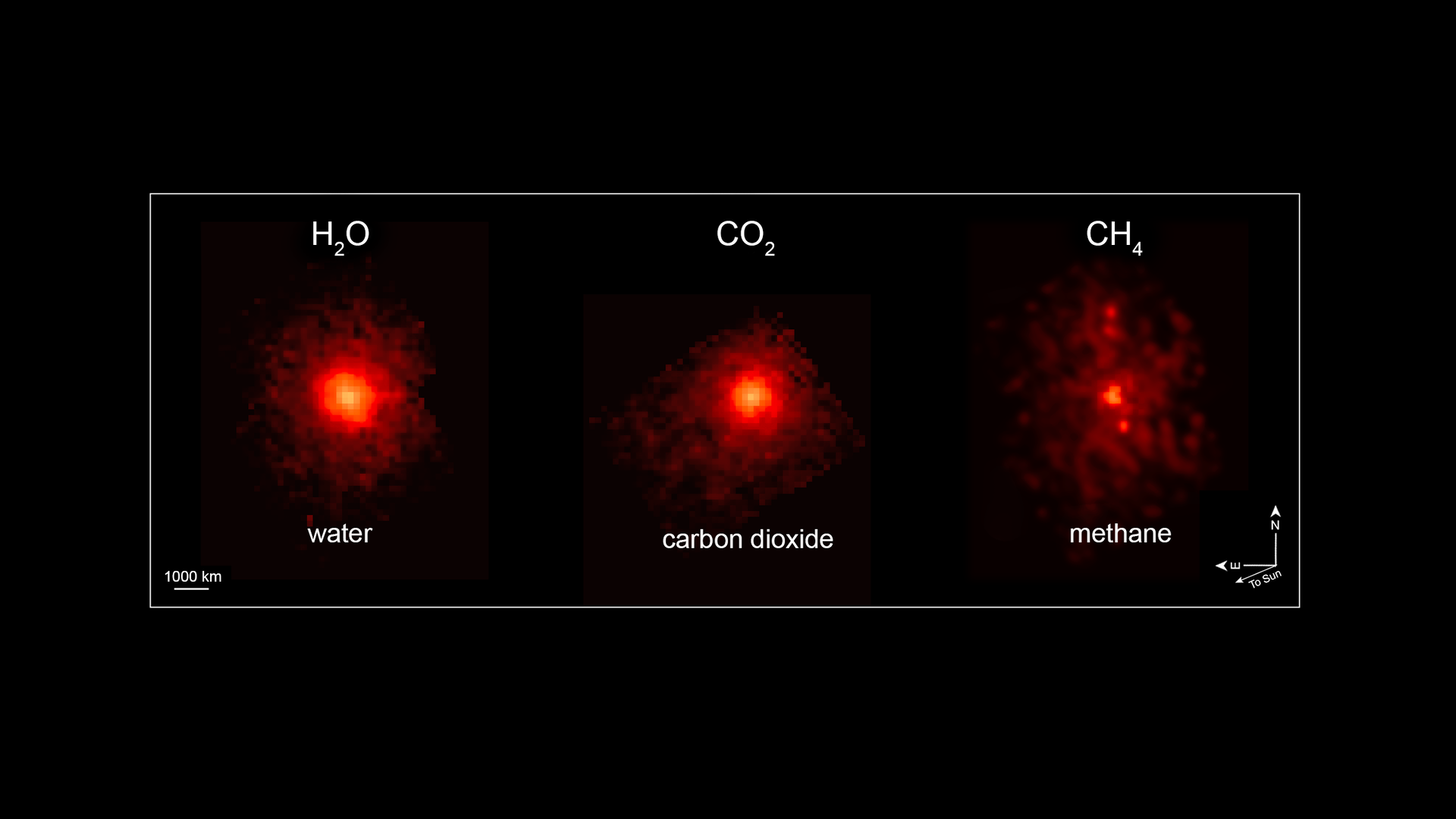
NASA/ESA/CSA, STScI (Webb MIRI gas maps)
A chemical fingerprint, read before it leaves forever
Comet 3I/ATLAS is leaving our neighborhood — and before it goes, the James Webb Space Telescope took one more look at it on the way out. Webb's mid-infrared instrument read the comet's chemical fingerprint after it whipped around the Sun, and the results are a genuine first.
For the first time on an object from beyond our solar system, Webb directly detected methane gas.
Why methane showing up now is the clue
Methane is highly volatile — it sublimates from solid ice into gas very easily, so it should have boiled away long ago. That it only appeared now suggests it was buried below the comet's surface, protected for who knows how long, until the Sun's heat finally reached the deeper ice.
The amount of methane relative to water is surprisingly high, with few similar analogs in our own solar system. Webb also confirmed the comet is unusually rich in carbon dioxide compared to water — far richer than typical comets born here.
Both findings point to a very different formation environment than the one that built our solar system.
What the image shows
The composite above is the actual Webb data: three maps from Webb's Mid-Infrared Instrument (MIRI) Medium Resolution Spectrometer, showing where each gas was located around the comet's nucleus. Water vapor spreads far beyond the nucleus because much of it is released from icy grains in the surrounding coma. Carbon dioxide and methane are more concentrated near the nucleus itself.
The observations were taken on two dates as the comet receded: December 15–16, when it was about 205 million miles (329 million km) from the Sun, and December 27 at about 236 million miles (379 million km).
No mysterious signals here
We'll say it plainly, because the rumors exist: every serious instrument that looked at 3I/ATLAS found the same thing — one solid, natural, active body. A preserved chemical sample from another star's neighborhood, billions of years old. A cosmic remnant, not a machine.
As it recedes, its gas production is shutting down. Water is going dark first — the least volatile of the three, so it shuts off fastest as the comet gets colder. Exactly as expected.
The farewell
3I/ATLAS is only the third interstellar object we've ever caught passing through — after 'Oumuamua in 2017 and 2I/Borisov in 2019. NASA confirms it poses no threat to Earth.
It'll drift back into the dark it came from, and we'll never see it again. But it left us its recipe: methane buried deep, carbon dioxide far richer than anything born in our system, and water shutting down first as the cold reclaims it.
A bottle of ice from another star, read out loud before it left.
Results published in The Astrophysical Journal Letters.
Source: NASA Science — read the original report
← Back to latest stories