October 11, 2026
A failed star 7.5 light-years away has weather — and it's changing
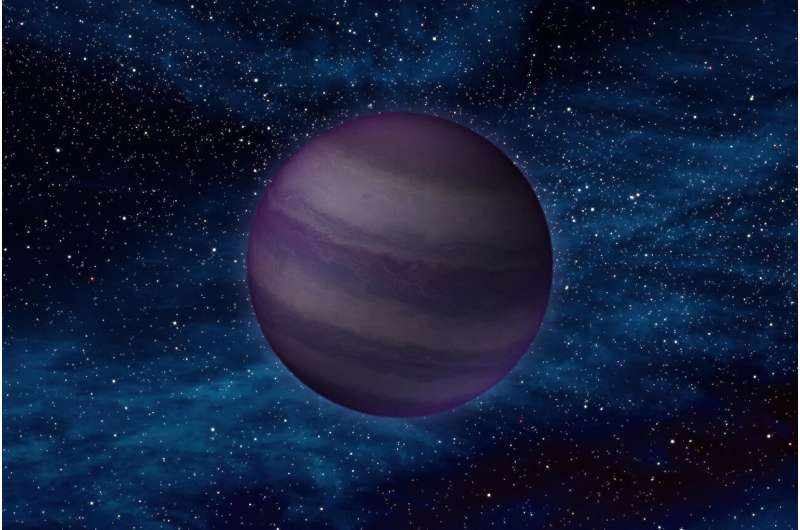
Artist's concept of a brown dwarf: NASA/JPL-Caltech (illustration — WISE 0855 itself is far too dim for portraits like this)
Seven and a half light-years away — practically next door, cosmically speaking — there's a world colder than a winter day on Earth, and it has weather.
The world is WISE 0855, the coldest known brown dwarf: a "failed star" about twice Jupiter's mass and roughly the same size, floating through space with no sun of its own. A team led by Brittany Miles of the University of Arizona's Steward Observatory pointed the James Webb Space Telescope at it for 11 straight hours, recording a full spectrum of its light every 15 minutes.
The result is the most detailed time-series portrait ever taken of such a cold object — and the first direct confirmation that water clouds on a body outside our solar system are thickening and thinning over time, the way weather works on Earth.
Two processes, untangled for the first time
Before Webb, telescopes could only measure WISE 0855's overall brightness, which mashed together the effects of clouds, chemistry, and temperature into one blurry signal. Webb's spectrograph changed that. By watching how individual molecules' signatures changed as the brown dwarf rotated, the team could separate the ingredients of its weather for the first time.
Two processes shape the atmosphere at once:
- Water clouds at high altitude that grow thicker and thinner as the object rotates, carrying different patches of cloud cover into view — like watching a slowly turning patchwork of warmer and cooler regions.
- Deep gases dredged upward by convection, including carbon monoxide and phosphine, churned from the hot interior toward the surface in a rhythmic, wavelike signal — the same disequilibrium chemistry that shapes Jupiter's atmosphere.
"This is the first time we've been able to confirm that water clouds are becoming thinner and thicker on a nearby world," said Miles. "Before JWST, we only had photometry, which mixed up the effects of clouds, chemistry and temperature all together. Now we can actually distinguish them."
Why it matters
Brown dwarfs sit in the strange middle ground between planets and stars — too massive to be planets, too small to ignite as stars, glowing dimly with leftover formation heat. WISE 0855, at roughly 265 kelvins (-8°C / 17°F), sits at the very bottom of that category and behaves, in many ways, like a free-floating giant planet.
The deeper point is universality. The physics of convection, clouds, and chemistry that governs Jupiter also governs this cold, starless world more than seven light-years away. If that physics is universal, it applies to the gas-giant exoplanets astronomers are now beginning to study in earnest with Webb — and to the weather they carry.
"We're seeing water clouds getting thicker and thinner, and deep gases rising and falling, and we can actually watch them change in real time," Miles said.
The research is on the arXiv preprint server and has been accepted for publication in The Astrophysical Journal.
The Discovery Wire reads the instruments out loud. Sources: Phys.org (Oct 9, 2026), reporting University of Arizona research accepted by The Astrophysical Journal.
Source: Phys.org — read the original report
← Back to latest stories