October 13, 2026
Webb Photographs the Coldest Exoplanet Ever Directly Imaged
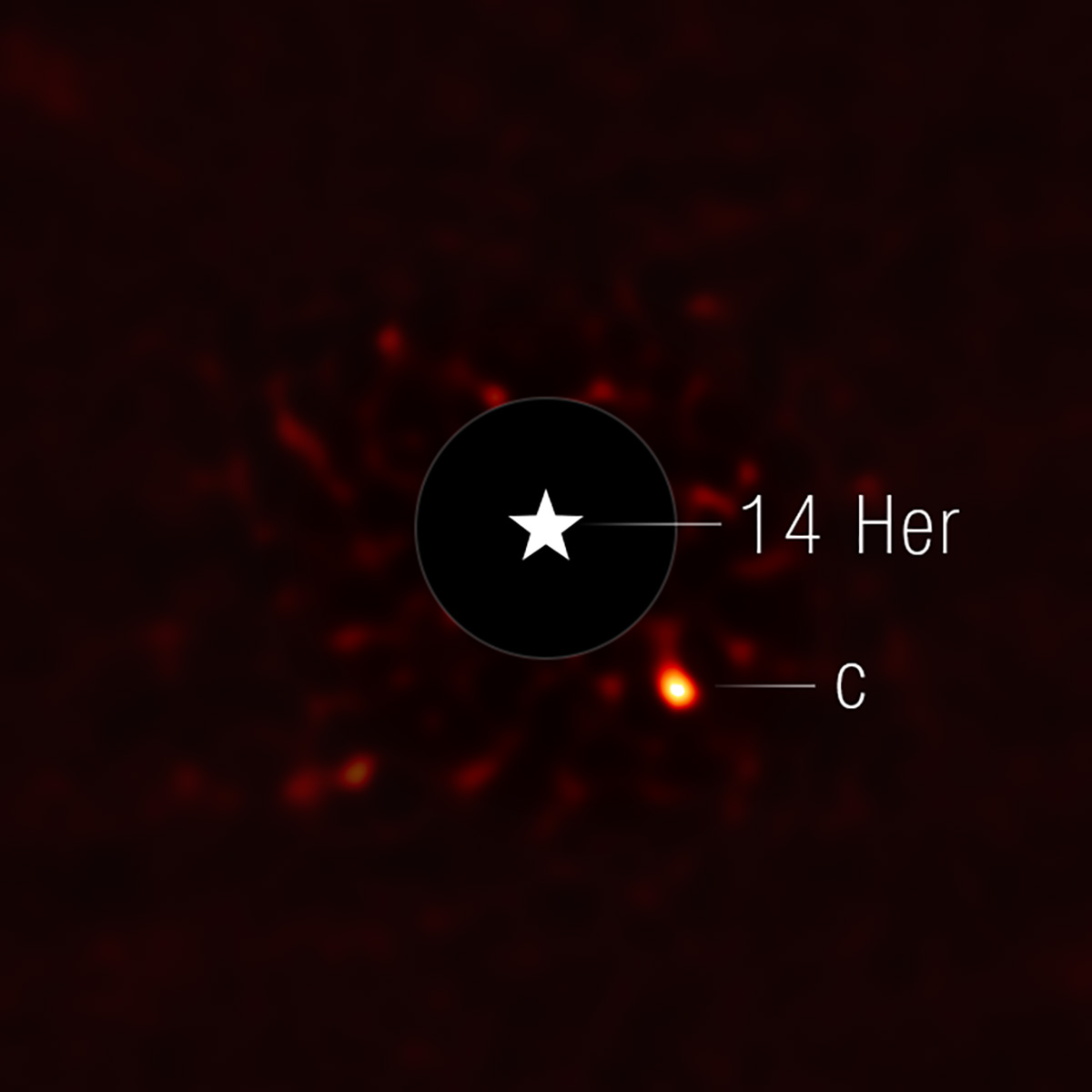
NASA, ESA, CSA, STScI; William Balmer (JHU), Daniella Bardalez Gagliuffi (Amherst College)
Webb Photographs the Coldest Exoplanet Ever Directly Imaged
The James Webb Space Telescope has captured a direct image of 14 Herculis c, a planet orbiting a star 60 light-years away — and it is the coldest exoplanet ever directly photographed.
About 6,000 exoplanets have been confirmed so far, but only a small fraction have ever been directly imaged. Nearly all of those are young and scorching — hundreds or even thousands of degrees. Cold planets barely glow in the infrared, so imaging them has been beyond reach. Webb's extreme infrared sensitivity has opened what the research team calls "a totally new regime of study."
A freezer-cold world
14 Herculis c is roughly seven times the mass of Jupiter, and its estimated temperature is about –3°C (26°F) — the coldest directly imaged exoplanet on record. Its host star, 14 Herculis, is similar to our Sun in age and temperature, though a little less massive and cooler.
To catch the planet, Webb used its coronagraph, an instrument that blocks the star's blinding light so far dimmer companions can show through. In the image, the dark disk marks where the star is hidden; the bright dot labeled "C" is the planet itself. (The system's second known planet, 14 Herculis b, is also covered by the coronagraph.)
A planetary crime scene
The 14 Herculis system is strange in a second way. Its two planets don't share an orbital plane the way our solar system's planets do. Instead, their orbits are tilted about 40 degrees from each other — they cross like an "X," and the planets tug at each other gravitationally as they orbit.
Astronomers have never before directly imaged such an orbital arrangement. The leading explanation: a third planet was thrown out of the system early in its formation, leaving the two survivors on tilted, irregular paths.
"We are seeing the aftermath of a more violent planetary crime scene," says William Balmer, the Johns Hopkins graduate student who co-led the study. He notes that our own early solar system was shaped by the same forces — our gas giants threw around asteroids and rearranged other planets — and that what happened at 14 Herculis could easily have happened here.
Refining the orbit and atmosphere
Webb's data also sharpened the picture of the planet's path and air. 14 Herculis c swings out about 1.4 billion miles from its star — roughly 15 times Earth's distance from the Sun, or between Saturn and Uranus in our terms — on a highly elliptical, egg-shaped orbit.
Measuring the planet's brightness at 4.4 microns, combined with its known mass and age, tells astronomers what's happening in its atmosphere. The planet is fainter than expected for an object of its mass and age, which the team attributes to carbon disequilibrium chemistry: carbon dioxide and carbon monoxide appear where methane should dominate at these temperatures, because fast atmospheric churning brings molecules made deeper and warmer up to the cold upper layers. The best-studied analogs, says co-first author Daniella C. Bardalez Gagliuffi of Amherst College, are the coldest brown dwarfs.
Why it matters
Direct imaging is how we study exoplanets as worlds rather than data points — light curves, dips, and wobbles. Adding cold, old planets to the directly imaged catalog means we can start comparing mature planetary systems to our own, rather than only catching planets in their hot, violent youth. 14 Herculis c is the first of that new class: a giant planet that has cooled for billions of years, with a tortured orbit as its backstory.
Source: BBC Sky at Night Magazine, October 13, 2026. The study's co-first authors are William Balmer (Johns Hopkins University) and Daniella C. Bardalez Gagliuffi (Amherst College).
Source: BBC Sky at Night Magazine — read the original report
← Back to latest stories