October 04, 2026
The Flash Was Only the Beginning: A Hidden X-ray Phase After a Neutron-Star Merger
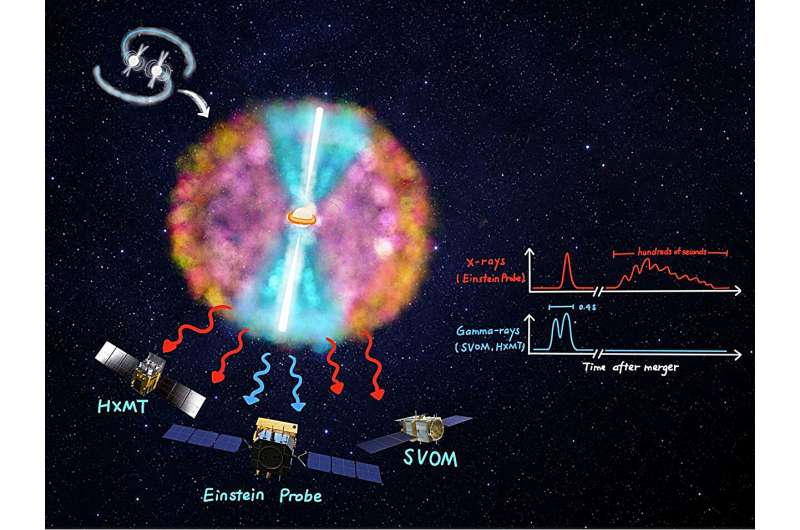
Illustration by Yi-Han Iris Yin; reference images: EPSC, SVOM collaboration, NSSDC
The Flash Was Only the Beginning: A Hidden X-ray Phase After a Neutron-Star Merger
When two neutron stars collide, the fireworks are fast. The gamma-ray burst — the signal astronomers have watched for decades — is over in about half a second. Blink and you've missed it.
This time, somebody watched with different eyes.
What happened
An international team led by researchers at Beijing Normal University, Nanjing University, and the University of Hong Kong tracked an event cataloged as EP250704a in X-rays and GRB 250704B in gamma rays — most likely the merger of two compact objects, such as neutron stars.
Three instruments caught it together: China's Einstein Probe, the Space Variable Objects Monitor (SVOM), and the Insight-Hard X-ray Modulation Telescope (HXMT).
The gamma-ray flash: about 0.4 seconds.
The soft X-ray emission that followed: nearly 10 minutes.
That longer phase is the find. It was published as a cover article in Science Bulletin — the sort of treatment a journal gives its most striking result.
Why it was hidden until now
Most X-ray telescopes only swing toward a burst after a gamma-ray detector has located it. The earliest X-ray emission may already be fading by the time anyone looks. Einstein Probe changes this: it continuously monitors a wide patch of sky at soft X-ray energies, so it was already watching when the event began.
"Einstein Probe is allowing us to uncover a part of compact star mergers that was hidden from previous gamma-ray observations," said Yi-Han Iris Yin, a Ph.D. student at the University of Hong Kong who led the analysis. "The short gamma-ray flash may represent only the beginning of the high-energy activity."
What the X-rays suggest
- The engine kept running. The X-rays' rapid flickering and changing spectrum indicate the central engine left behind by the merger kept releasing energy long after the flash.
- The remnant might be a magnetar. One explanation: a rapidly rotating, intensely magnetized neutron star powering the X-ray glow.
- This may be common. Similar soft X-ray phases may have accompanied earlier short gamma-ray bursts all along — too soft and faint for conventional gamma-ray instruments to catch.
If so, astronomers have been watching only the opening frame of a much longer movie.
The people behind the result
The analysis was led by HKU Ph.D. student Yin, working with An Li of Beijing Normal University, Bin-Bin Zhang of Nanjing University, and teams spanning Nanjing, Rome, the Chinese Academy of Sciences, and the Institute of High Energy Physics. Bing Zhang, founding director of HKU's Hong Kong Institute for Astronomy and Astrophysics, co-authored the study — he has long argued that binary neutron star mergers should produce fast X-ray transients exactly like this, and Einstein Probe has now started finding them.
This is public science, reported — not a discovery of our own. Reference: An Li et al., "Minutes-long soft X-ray prompt emission from a compact object merger," Science Bulletin (2026).
Source: Phys.org (Oct 4, 2026), reporting a cover article in Science Bulletin — read the original report
← Back to latest stories