October 20, 2026
The 3,700-Year-Old Printing Press Nobody Can Read
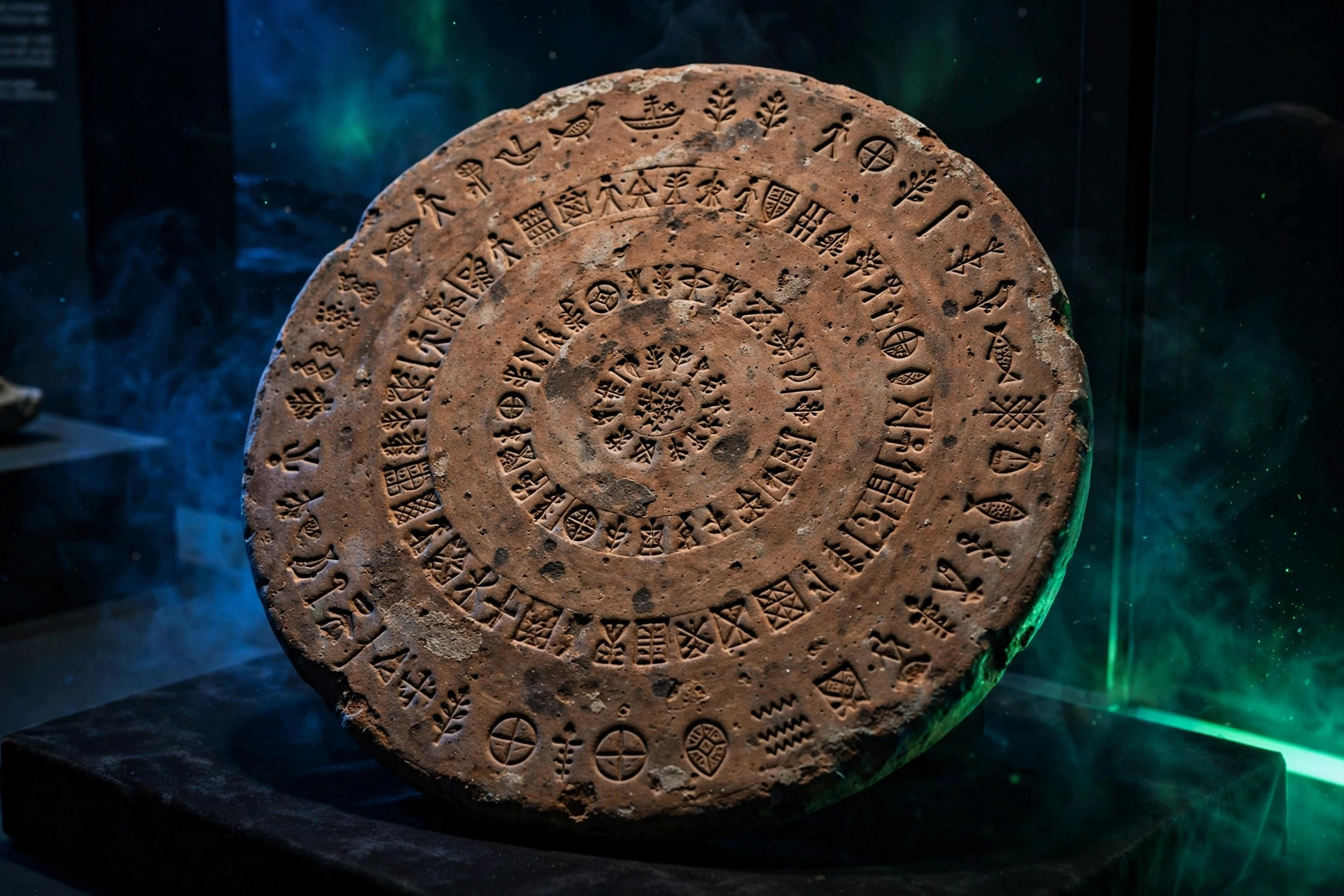
Illustration: The Discovery Wire (generated artwork for this story)
The 3,700-Year-Old Printing Press Nobody Can Read
On July 3, 1908, Italian archaeologist Luigi Pernier was excavating the Minoan palace of Phaistos on the island of Crete when his team turned up something that shouldn't exist: a disc of fired clay, about the size of a dessert plate, covered on both sides with a spiral of tiny stamped pictures.
The object
The disc is roughly 15 centimeters across and carries 241 symbols pressed in from 45 distinct hand-carved stamps — 123 on one face, 119 on the other. Human figures, fish, birds, insects, plants, a boat, a shield, a staff. Each symbol was pressed into soft clay with its own individual seal, in a clockwise spiral winding toward the center, and then the disc was fired hard.
That makes it the earliest known printed document in human history — movable type, nearly three thousand years before Gutenberg. Incised lines divide the symbols into 61 groups, which may be words.
It was found in a small underground chamber of the palace complex, lying amid ashes, burnt cattle bones, and pottery sherds — only a few centimeters from a small tablet written in Linear A, another Minoan script we only half-understand. The disc dates to roughly 1750–1650 BCE, the Middle Minoan period.
The 45-sign clue
The number of distinct signs is itself a clue. Most researchers believe the script is a syllabary, like Japanese katakana or hiragana, where each sign stands for a syllable. Alphabets have around 20–30 letters; logographic scripts like Chinese have thousands of characters. Forty-five signs sits right in the syllabary zone.
And yet: while the disc's unique features once made some scholars suspect a forgery, it is now generally accepted by archaeologists as authentic.
The real problem
The real problem isn't the signs — it's the context. This is the only one. No second disc, no bilingual inscription, no Rosetta Stone. Dozens of decipherment proposals have been published over the past century — prayers, adventure stories, calls to arms, even a geometric theorem — and none has survived scrutiny. The honest scholarly consensus: without more examples of the signs, there isn't enough context for a meaningful analysis.
The disc now sits in the Heraklion Archaeological Museum in Crete, in a glass case you can walk around to see both faces. Its mystery is so famous it has its own Unicode block, its own presence on postcards and museum merchandise across Greece — and it still refuses to be read.
The open question
Here's the part that keeps us up at night: we don't even know if it was a message. It might be a prayer, an inventory, a law, a hymn, a board game — or the 3,700-year-old equivalent of a prank. Someone carved 45 stamps, pressed 241 symbols into clay with real care (the disc shows traces of corrections), fired it to permanence, and left it in a palace chamber.
If it was a message, it worked — we're still talking about it. We just can't talk about what it says.
Sources: Wikipedia, "Phaistos Disc"; thefreedictionary.com encyclopedia; cromwell-intl.com (Phaistos / South-Central Crete). All facts verified 2026-10-20. The disc is a genuine undeciphered artifact; no solution is claimed here.
Source: Wikipedia ("Phaistos Disc") — read the original report
← Back to latest stories