October 04, 2026
He Was Looking for a Campsite. He Found a 390-Million-Year-Old Impact Crater.
NASA Earth Observatory/Lauren Dauphin
He Was Looking for a Campsite. He Found a 390-Million-Year-Old Impact Crater.
Some scientific discoveries come from billion-dollar observatories. This one came from a guy planning a camping trip.
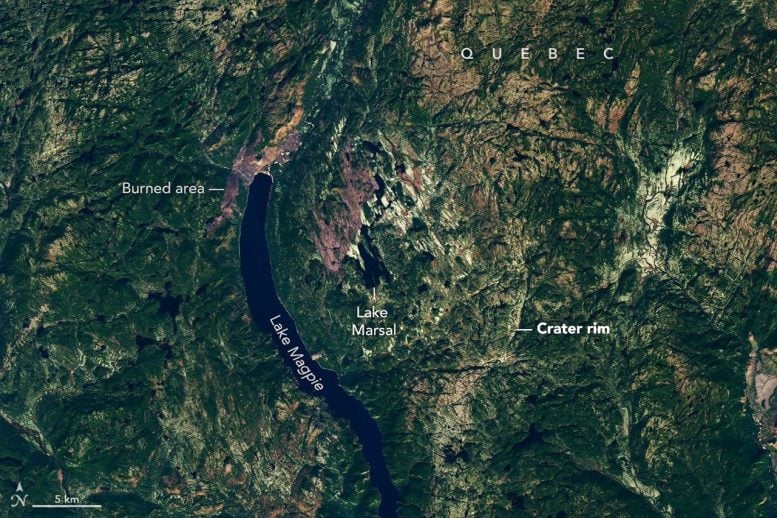
In 2024, amateur astronomer Joël Lapointe was browsing online satellite imagery, scouting Quebec's remote Côte-Nord region for a campsite, when a strange circular feature near Lake Marsal caught his eye. It didn't look quite like anything else on the map. He wondered if it could be an impact crater — and started emailing specialists in Europe and North America to ask.
That one question set a whole chain of events in motion.
From skepticism to shatter cones
Lapointe's inquiry eventually reached Gordon Osinski, a planetary geologist at Western University who also directs the Impact Earth database of the world's confirmed impact structures. Osinski was skeptical at first — but curious enough to organize an expedition to the isolated site in October 2025.
Getting there was its own ordeal. The team flew in by floatplane, but the aircraft couldn't reach the shoreline, so the researchers waded 50 meters through water with their equipment. The terrain beyond was, in Osinski's words, "deep, twisty, gnarly vegetation" — swampy, rough, and swarming with insects. He has done fieldwork on six continents; he called this one of the toughest environments he's ever encountered.
Earlier surveys had dismissed the local rocks as evidence of a volcanic diatreme. But by the expedition's second day, the team started finding shatter cones — distinctive ridged rock structures produced only by the immense pressures of an impact.
"It's the only unequivocal evidence of an impact event that you can see in the field with the naked eye," Osinski said.
A 25-kilometer scar
The object responsible produced a complex crater measuring 25 kilometers (16 miles) across, complete with a central uplift and high cliffs of columnar jointing. Analysis of the collected rocks dates it to roughly 390 million years ago — about 100 million years before a major increase in impact cratering on Earth that researchers have linked to collisions within the asteroid belt.
An impact of comparable size in populated Quebec today would be catastrophic. Osinski said it would cause "regional devastation on a scale that would wipe out major cities and have global climate impacts."
Following discussions with the Innu Council of Ekuanitshit, the researchers named the structure Uhackatik. The team considers its impact origin essentially confirmed, though formal recognition by a Meteoritical Society committee is still pending. It is the largest impact crater discovered since the 31-kilometer Hiawatha structure was identified under Greenland's ice sheet in 2018.
Osinski also helps train NASA's first Artemis astronauts in geology — but don't expect Uhackatik to become a training site. It's just too hard to reach. A younger, friendlier crater in Labrador (Kameshtashtan, or Mistastin Lake) has already hosted astronauts in the past.
The moral of the circle on the map
For Lapointe, seeing his hunch confirmed was unforgettable. He told CityNews he was "over the Moon" when researchers determined the structure really was an impact crater, adding: "I encourage everyone to not ignore intuition or an observation, even if it isn't part of your field of expertise."
There are only about 200 confirmed impact structures on Earth, though geologists estimate hundreds more are still waiting to be found. One of them was hiding in plain sight — in satellite maps anyone can open — until someone asked the right question.
And NASA agrees that curious eyes still matter: the agency runs public citizen-science projects where anyone can help hunt asteroids and comets (Daily Minor Planet), watch the Moon for meteoroid impact flashes, or search for evidence of asteroids beyond our Solar System.
Somewhere out there, the next Uhackatik is sitting in a browser tab, waiting for a person who doesn't know what they're looking for.
Source: SciTechDaily
Source: SciTechDaily — read the original report
← Back to latest stories